Source: official English rulebook by Aki Watakabe / J&M SPACE
Entertainment, Canva view page https://www.canva.com/design/DAGe_pc1Ymo/5FQsrltu0gvHtXjH7KSs7A/view
(linked from the author's Game Market page https://www.gamemarket.jp/game/184952).
Text extracted verbatim from the design data on 2026-10-09; only
re-ordered into sections and line-wrapped. Where the printed text only
makes sense together with a picture, the picture is described in a
> [Figure] note. Translation slips are kept as printed;
see §9 for the places where the Japanese rulebook is clearer or
differs.
Age 7+ · 2–4 players · 20 mins
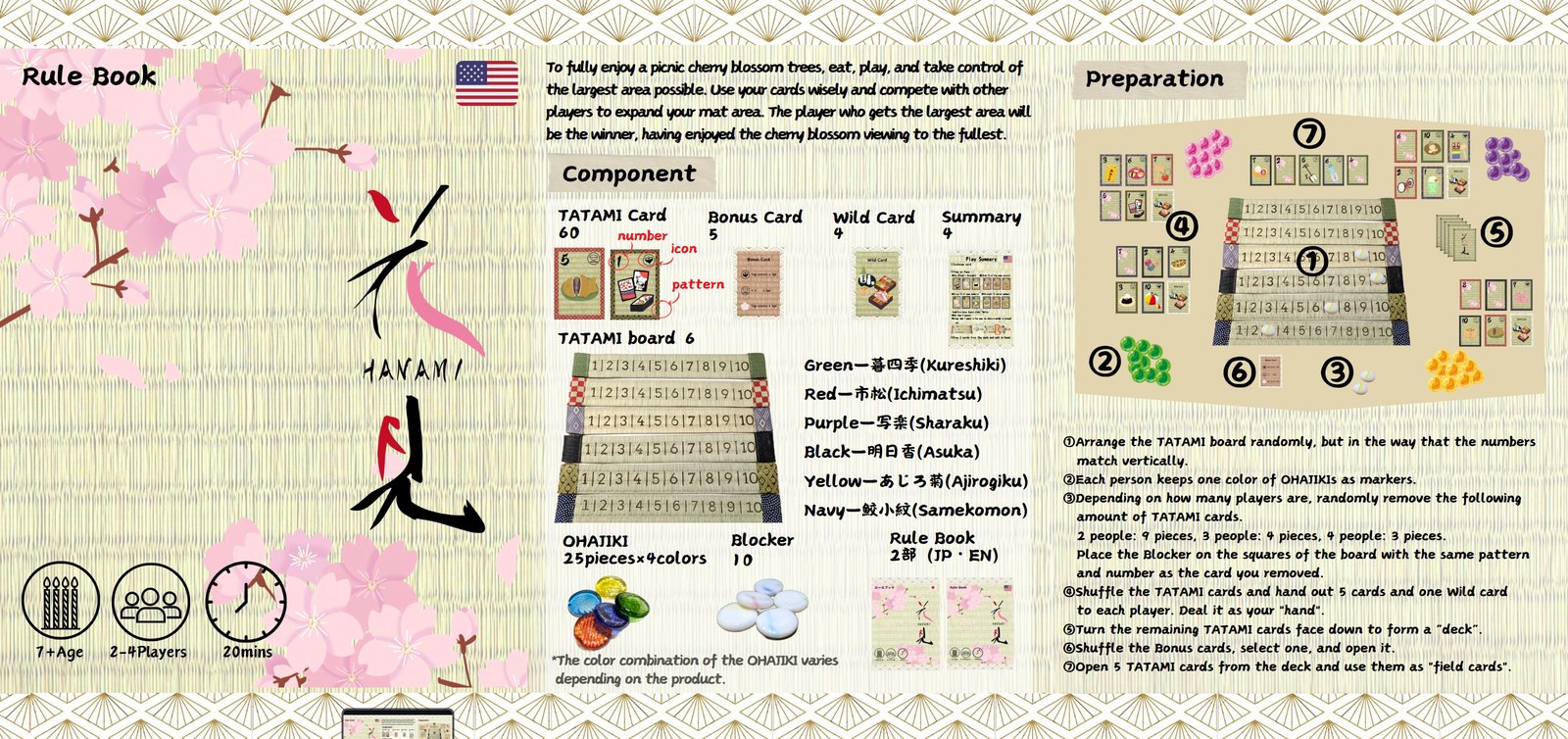
To fully enjoy a picnic cherry blossom trees, eat, play, and take control of the largest area possible. Use your cards wisely and compete with other players to expand your mat area. The player who gets the largest area will be the winner, having enjoyed the cherry blossom viewing to the fullest.
| Component | Qty | Notes |
|---|---|---|
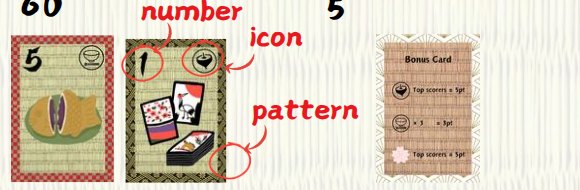
| TATAMI Card | 60 | Each card has a number (1–10), an icon (top-right circle) and a pattern (card frame = one of the 6 tatami-edge patterns). 6 patterns × numbers 1–10. |
| Bonus Card | 5 | Each lists icon-scoring conditions used at game end. |
| Wild Card | 4 | One per player. |
| Summary | 4 | "Play Summary" reference cards (JP/EN). |
| TATAMI board | 6 | Long strips, each printed with squares 1–10 and one edge pattern. |
| OHAJIKI | 25 pieces × 4 colors | Glass markers; one color per player. *The color combination of the OHAJIKI varies depending on the product. |
| Blocker | 10 | White pieces placed on removed cards' squares. |
| Rule Book | 2 (JP · EN) |
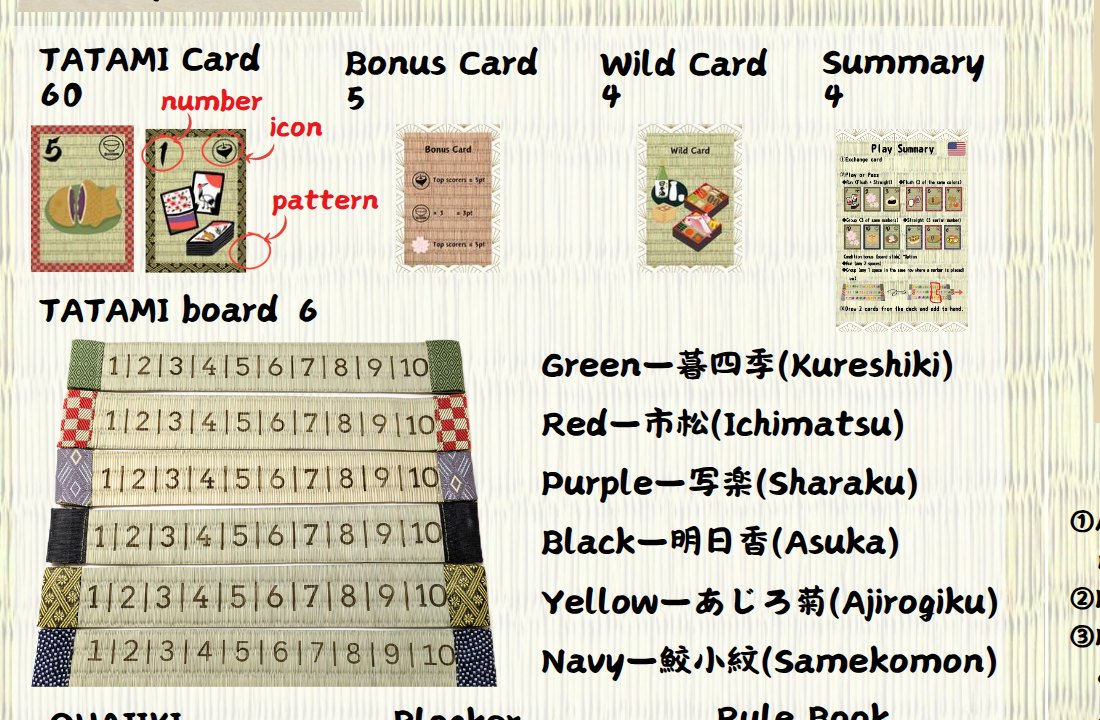
Pattern names (board edge / card frame):
[Figure] The 6 boards stacked as rows form a 6 × 10 grid; the four corner squares of that grid are the "corner squares" used in scoring.
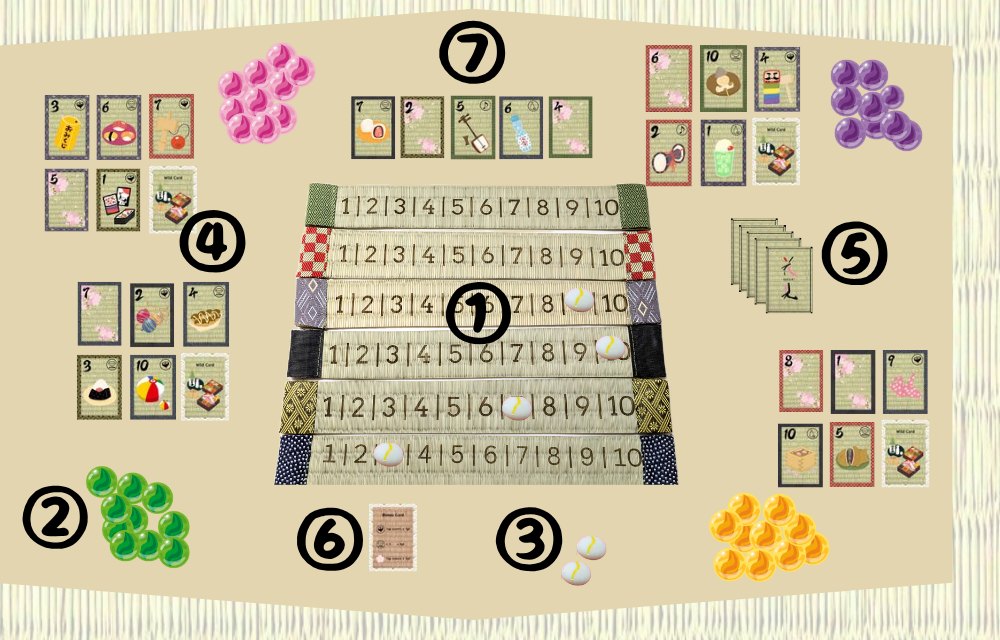
[Figure] Boards in the middle (①), one color of OHAJIKI per player (②), Blockers on the boards (③), hands (④), deck (⑤), the open Bonus card (⑥), 5 face-up field cards (⑦).
※ The person who has recently seen the cherry blossoms is start player. When your turn comes, proceed from ① to ④.
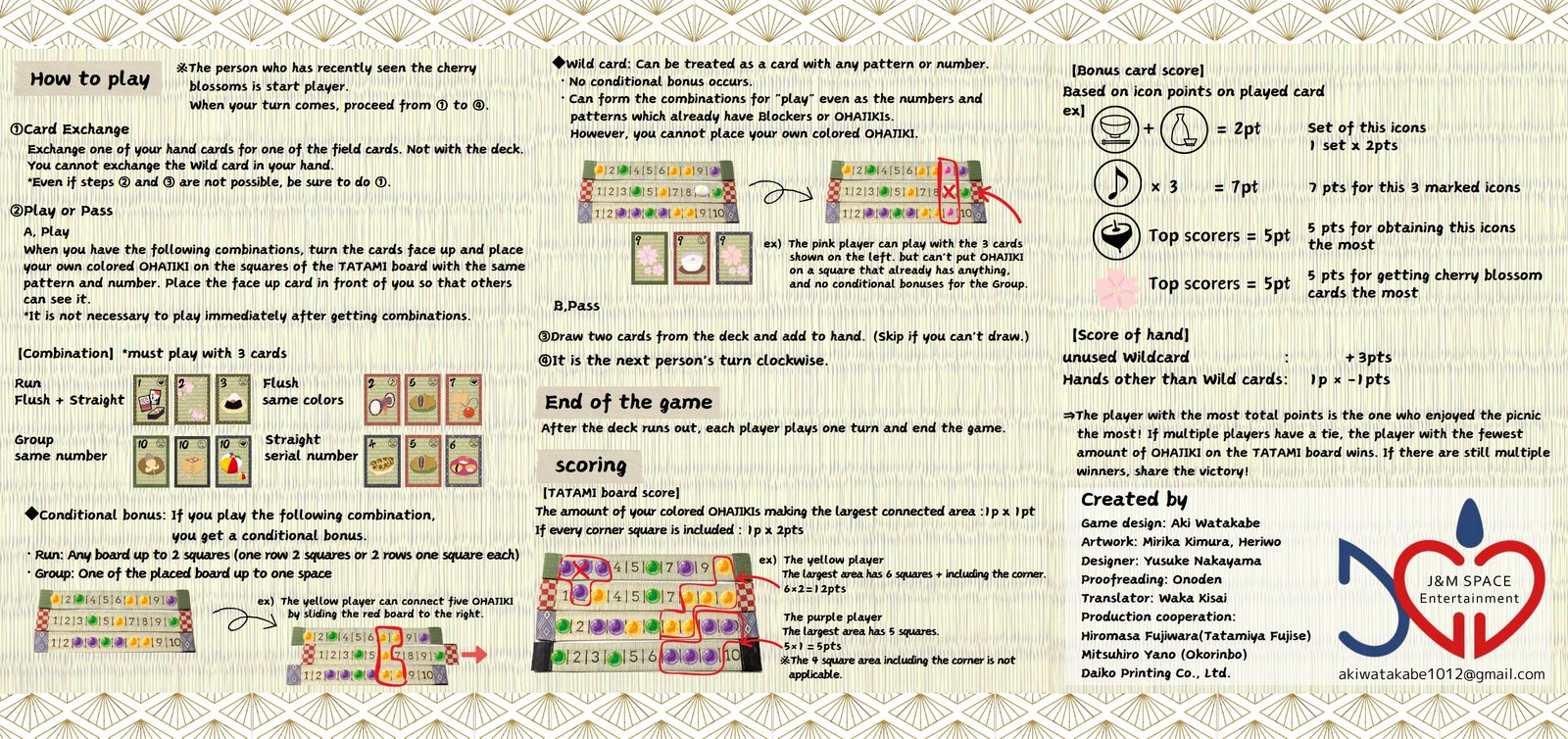
Exchange one of your hand cards for one of the field cards. Not with the deck. You cannot exchange the Wild card in your hand. *Even if steps ② and ③ are not possible, be sure to do ①.
A, Play When you have the following combinations, turn the cards face up and place your own colored OHAJIKI on the squares of the TATAMI board with the same pattern and number. Place the face up card in front of you so that others can see it. *It is not necessary to play immediately after getting combinations.
B, Pass
Draw two cards from the deck and add to hand. (Skip if you can't draw.)
It is the next person's turn clockwise.
【Combination】 *must play with 3 cards
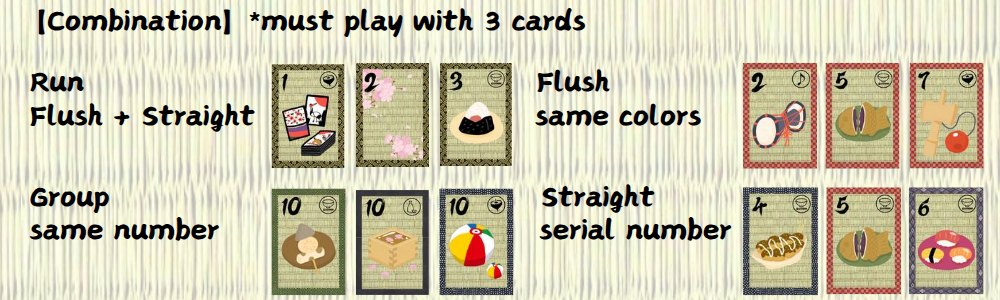
| Combination | Definition (printed) | Example in the figure |
|---|---|---|
| Run | Flush + Straight | 1, 2, 3 all green frame |
| Flush | same colors | 2, 5, 7 all red frame |
| Group | same number | 10, 10, 10 (green, yellow, black) |
| Straight | serial number | 4, 5, 6 (yellow, red, red) |
"Colors" = the card frame pattern (= board pattern). A play is always exactly 3 cards. Playing puts one OHAJIKI on each of the 3 matching (pattern, number) squares.
◆ Conditional bonus: If you play the following combination, you get a conditional bonus.
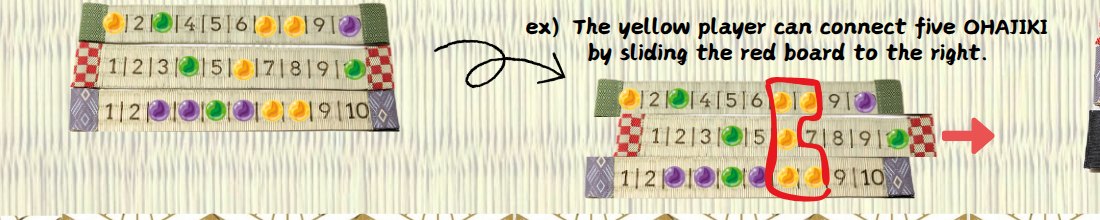
ex) The yellow player can connect five OHAJIKI by sliding the red board to the right.
[Figure] Boards slide sideways (left/right) relative to the other boards, shifting which squares line up vertically. In the example the red board is pushed one square right so the yellow markers in the rows above and below become vertically adjacent to it.
◆ Wild card: Can be treated as a card with any pattern or number.
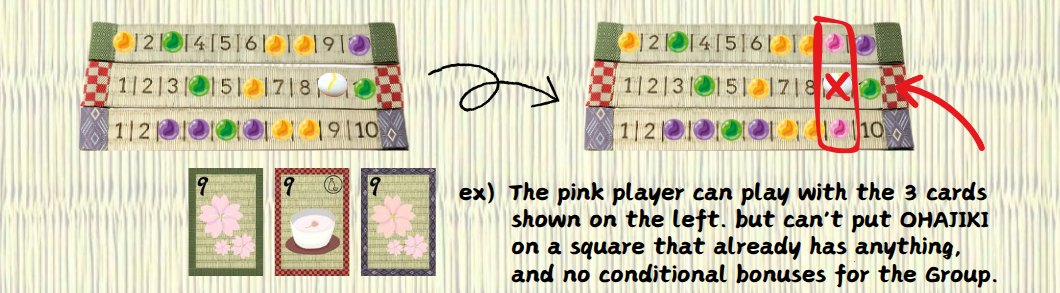
ex) The pink player can play with the 3 cards shown on the left. but can't put OHAJIKI on a square that already has anything, and no conditional bonuses for the Group.
[Figure] Pink plays green 9, red 9 and navy 9 as a Group. Red 9 already holds a piece, so pink places only on green 9 and navy 9 (the red 9 square is marked ✕), and no board slide.
The only "removal" in the rules is in Setup ③: the TATAMI cards removed for the player count (9 / 4 / 3 cards for 2 / 3 / 4 players) have their squares covered with Blockers, so nobody can ever place there. A Wild card may still represent a blocked card for forming a combination (see §4 Wild card), but no OHAJIKI goes on a blocked square. OHAJIKI are never removed once placed.
After the deck runs out, each player plays one turn and end the game.
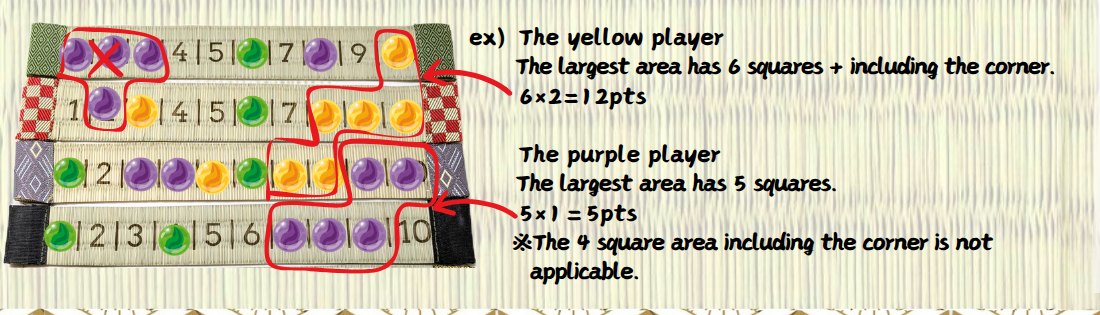
ex) The yellow player — The largest area has 6 squares + including the corner. 6 × 2 = 12pts The purple player — The largest area has 5 squares. 5 × 1 = 5pts ※ The 4 square area including the corner is not applicable.
[Figure] "Connected" is horizontal/vertical adjacency across the 6 × 10 grid (the Japanese text says 上下左右). Only the largest area counts; the doubling applies when that area contains one of the four corner squares of the grid. Purple's 4-piece corner group does not count because purple's largest group is a different 5-piece group.
Based on icon points on played card (icons on the cards you have played in front of you).
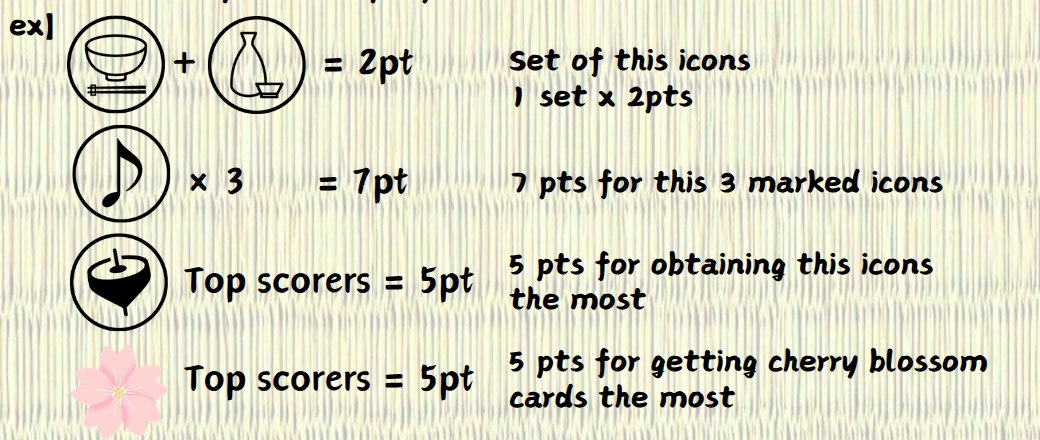
ex] (the Bonus card shown)
| Icon condition | Points |
|---|---|
| Set of this icons (bowl-with-chopsticks + sake bottle) | 1 set × 2pts |
| 7 pts for this 3 marked icons (music note × 3) | 7pt |
| 5 pts for obtaining this icons the most (spinning top) | Top scorers = 5pt |
| 5 pts for getting cherry blossom cards the most | Top scorers = 5pt |
⇒ The player with the most total points is the one who enjoyed the picnic the most! If multiple players have a tie, the player with the fewest amount of OHAJIKI on the TATAMI board wins. If there are still multiple winners, share the victory!
Created by — Game design: Aki Watakabe · Artwork: Mirika Kimura, Heriwo · Designer: Yusuke Nakayama · Proofreading: Onoden · Translator: Waka Kisai · Production cooperation: Hiromasa Fujiwara (Tatamiya Fujise), Mitsuhiro Yano (Okorinbo), Daiko Printing Co., Ltd. J&M SPACE Entertainment.
Checked line by line against rules_ja.md (2026-10-09).
No rule conflicts; the Japanese text is more precise in five
places, and the English has one misleading phrase.
| # | Topic | English says | Japanese says | How to play it |
|---|---|---|---|---|
| 1 | Corner bonus | "If every corner square is included: 1p × 2pts" | 「そのエリアに四隅のマスが含まれる場合は、上記点数の2倍」= if the area contains (any one of) the four corner squares, double it | Follow JP; the EN worked example (one corner → ×2) also confirms it. |
| 2 | What counts as connected | "largest connected area" | 「上下左右繋がっている」= connected orthogonally | Orthogonal only; diagonals do not connect. |
| 3 | Board slide direction | "Any board up to 2 squares" | 「左右にスライドできる」= slide left/right | Boards only slide sideways along their length. |
| 4 | Bonus "top scorers" ties | silent | 「※最多同値の場合は該当者全員加点」= if tied for most, every tied player scores the 5 pts | All tied players get 5 pts. |
| 5 | Wild card cannot be exchanged | stated under ① Card Exchange | stated in the Wild card box (「①のカード交換には使えない」) | Same rule, different place. |
| 6 | End trigger wording | "After the deck runs out, each player plays one turn and end the game." | 「山札がなくなったら、そこから1手番ずつプレイして終了。点数計算へ」= once the deck is gone, play one turn each from there, then score | Same meaning. Neither text says whether the player who empties the deck counts as one of the final turns; see the quick-reference note. |
| 7 | Components | "Rule Book 2部(JP・EN)" | 「ルールブック 2部(日・英)」 | Same. |
Open points not settled by either text: (a) if only 1 card remains in the deck at step ③, whether you draw 1 or skip; (b) whether the end-game "one turn each" starts with the player after the one who drew the last card. Both are table rulings.
Rulebook © Aki Watakabe / J&M SPACE Entertainment. Source: official rulebook linked from Game Market.